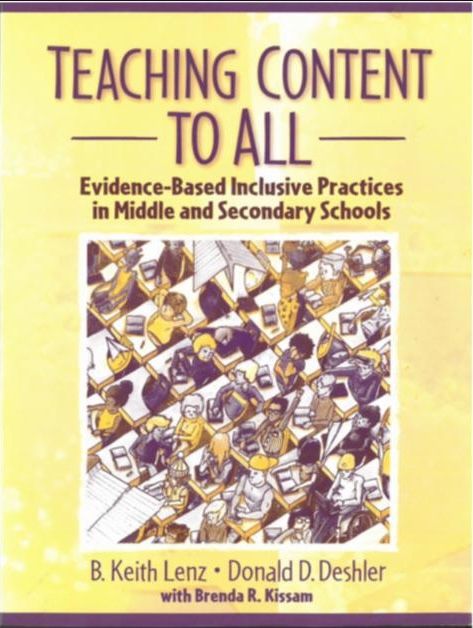
Teaching Content to All: Evidence-Based Inclusive Practices in Middle and Secondary Schools
$0.00
Newly Added!
SMARTER Instructional Cycle
Save this product for later
Teaching Content to All: Evidence-Based Inclusive Practices in Middle and Secondary Schools
Product Details
The goal of this book is to help prepare teachers to respond to the demands of academic diversity found among students and teachers in middle schools and high schools. In the midst of standards-based school reform, a pressing issue for teachers and reformers is how to ensure that all students have access to the curriculum and effective instruction. All students must be supported in ways that will enable them to meet the standards set by states and local school districts.
This text is designed to provide secondary teachers with effective planning and teaching routines to help them address the learning needs of all students and create a truly inclusive classroom environment. While this text supports inclusive instruction in many respects, it does not, as most inclusion texts do, deal only with inclusion of students with special needs, such as English language learners or students with high-incidence disabilities. This text deals with academic diversity and with planning and teaching for a diverse class. It is what all secondary teachers need to know when they have students with many different types of learning needs. So, for example, the text does not discuss specific adaptations for students with hearing impairments; however, it does deal with the dilemma of what content is important if you are going to make adaptations for someone who is hearing impaired when you have 30 other students in your history class.
The traditional approach to inclusion is to list many methods and many adaptations appropriate for different types of disabilities. However, it is clear that implementing and sustaining a wide variety of individualized adaptations is impossible for most secondary teachers, who may teach as many as 150 students each day. Furthermore, teachers might adapt some unimportant content if they have not thought through what content students need to learn. Therefore, focusing only on how individual needs should be met is insufficient.
The methods presented here are effective for instruction of students in middle schools, junior high schools, and high schools, primarily covering grades 4 to 12. Concepts, strategies, and classroom-based activities are provided that can be used by teachers to understand differences among learners and then to plan and teach in ways that respond to learning needs arising from those differences. The book also includes a broad set of materials based on research conducted in hundreds of classrooms by researchers from the University of Kansas Center for Research on Learning.
Find this and more articles and resources from the University of Kansas Center for Research on Learning on KU Scholarworks.
Display prices in:USD